

Maastricht Walking Route details
This walk is ideal for everyone, whether you are out and about with children or want to spend a pleasant time with friends. Be surprised on a journey of discovery full of fascinating stories and rich history. The route is suitable for everyone, so families, couples and friends can fully enjoy the beauty of Sint Pietersberg Maastricht. You start and end this free Maastricht city walk at the Fort Sint Pieter. Put on your walking shoes, bring your binoculars and let's hit the road!
Distance: 5.0 km | Duration: 1 hour
Tip: download the Sint Pietersberg walk as a GPX file and open the route in a GPX viewer app.
Still prefer a guided tour? Then take a look at our offer below- and above-ground Maastricht:
Welcome to the Sint Pietersberg
The Sint Pietersberg is an indispensable part of any Maastricht walking route! This is actually a plateau, carved out by Maas and Jeker, but we call it a mountain. That's what it feels like when you walk here on your free Maastricht city walk. You are now in the southernmost part of the Netherlands. The rare limestone slopes and unique microclimate make the area a unique butterfly, eagle owl, bat and plant paradise.
Go ahead and explore Fort Sint Pieter before we start the walk. You can walk around in the Fort's dry moat and count all the embrasures. There are a lot of them! Fort Sint Pieter was built around 1701 -1702 by order of Baron Daniël Wolff von Dopff. It was built in a pentagon to defend the southern ramparts of Maastricht. Did you know that up to 450 soldiers could be at work in the Fort? This happened only once in history, when it was under fire from Lauberg hill. As a matter of fact, the Fort was never conquered. Czaar Peter the Great visited the Fort when he was passing through in 1717. High visit. You too can visit the inside of the Fortress with a guide from Maastricht Underground.
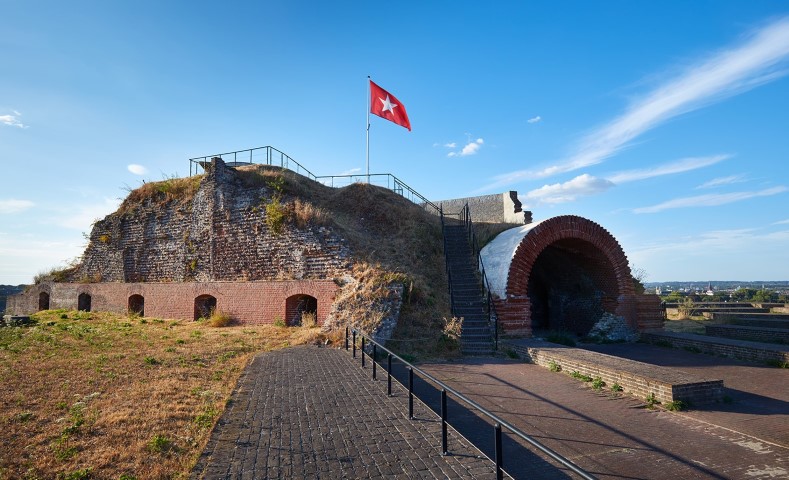
View over Maastricht and Jekerdal
On the west side of the Fort, you can get to the top of the Plateau of Sint Pietersberg via the stairs, or a little more adventurously via the steep path. When you get to the top, you are sure to see the red bench. Here you have a great view of the Fort and over the city. You can also see the many (church) towers from here. The red tower of Saint John's Church, the towers of Saint Servatius' Basilica and Our Lady's Basilica. But you can also see the towers of the former government building (Provincial House) that now houses the university. Which towers can you still discover?
When you are rested from the climb up, continue diagonally across the plateau towards the west. Until you see another bench on your right. If there is room, sit down for a while and enjoy the beautiful view. Here you look out over the Jeker valley with the Apostelhoeve's vineyards proudly across the street. The Apostelhoeve was one of the first post-war vineyards in the Netherlands, they have been making wine since 1970. Long ago in the Middle Ages, wine grapes were already being grown in the Jeker valley. Until the Little Ice Age, then it came to an end. Today, more than 100,000 bottles of wine are produced annually.
Lookout Oehoe Valley
Let's move on! Keep walking on the west side or run across the grassy field, of course! If you don't run across the grassy field, you'll come across several paths to the right after a slight left turn. Choose the path that leads into another grassy field. Follow the path and turn left at the end. Then on your right you will see an observation post, 'the Kiekoet'. That means shop window in Maastricht. Here you look through the bird-watching screen overlooking the Oehoe Valley (part of the ENCI quarry).
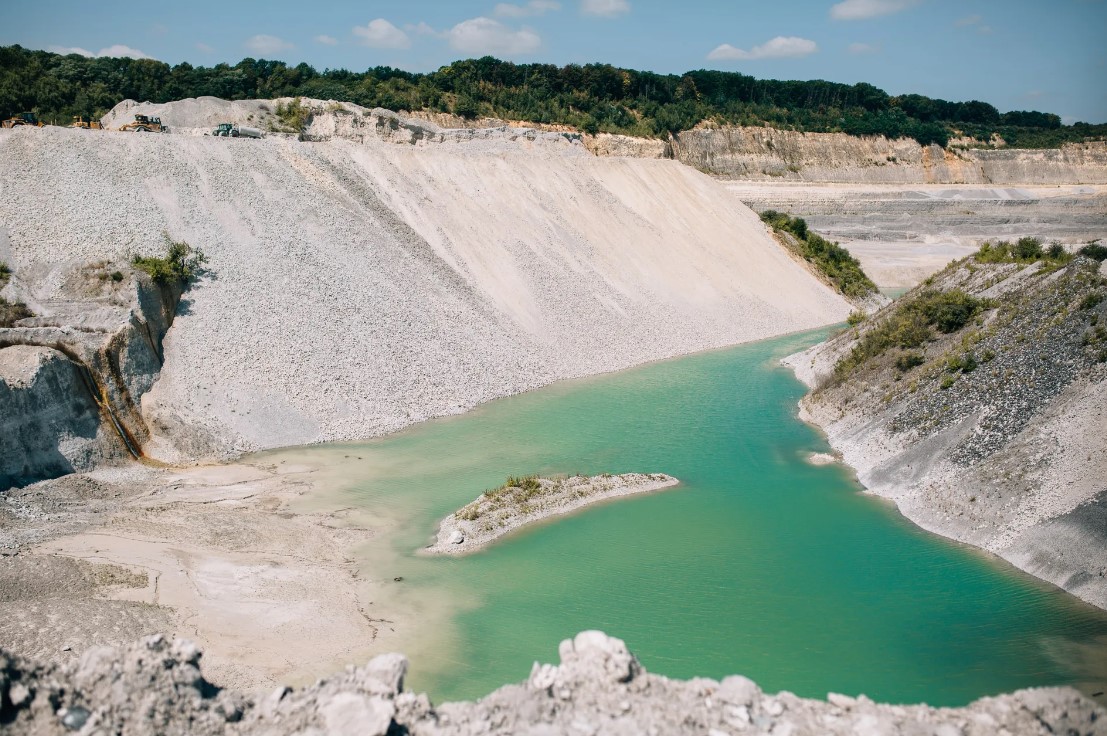
This quarry is now home to lots of different animals such as butterflies, foxes and the eagle owl. The Eagle Owl has been breeding here since 1997, which is very special. The eagle owl sometimes nests on the left and sometimes on the right side of the valley. If you look through the binoculars standing by the Kiekoet you might be able to see it, but you'll have to look very carefully. The eagle owl does not fly around here during the day, but you never know! At the Kiekoet there is a lot of information about the eagle owl.
Leave the "Kiekoet" on the right and continue the path to the T-junction. At the T-junction, turn right. You are now walking towards the platform at the ENCI quarry and the stairs leading into the quarry. On the platform you look out over the ENCI quarry. The platform symbolises a road that disappeared due to marl mining. Take a good look around at what you can see here.
Do you have the time and energy to descend a bit of the stairs? Here you will enter part of the marl caves. Here you can clearly see how the marl used to be carved, first by the block breakers and then by ENCI. The ENCI company was the First Dutch Cement Industry. Once at the bottom of the stairs, you can see fossils in the marl wall. Rub your hand through the marl on the ground. Did you know that your hands go through millions of fossils here?
Mosasaurs were found in this quarry! This dino is named after the river Meuse that flows through Maastricht. Mosa is the Latin word for Maas and Saurus is the Latin word for Lizard-like, i.e. Maas lizard. The Mosasaurs lived about 82 million years ago and were big predators in the sea that was here then. Shark teeth have also been found in the quarry! Five teeth were found from an extinct shark that could grow up to 5 metres long! It lived during the time when there was a subtropical inland sea here, right where you are standing now! How extraordinary is that? At the Natural History Museum in Maastricht, you can learn all about the finds of these prehistoric animals.
Climb back up then we will continue exploring. Follow the road and take the first right at the big boulders (maybe you can climb up and jump off for a while, be careful though!). We are heading towards Hoeve Lichtenberg.
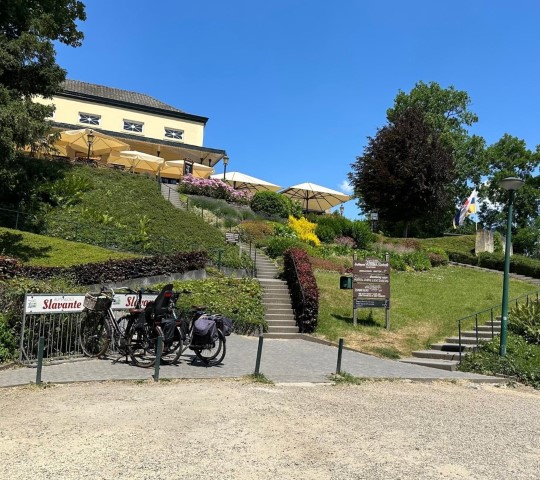
Restaurant with playground on Sint Pietersberg
You are now walking on a part of the mountain where there are many badger setts. Just as humans dug all kinds of corridors in the mountain, the badger does the same. The badger makes all kinds of rooms in the corridors. They live in the corridors underground. Could humans do the same? Maybe we will come across another cave dwelling. Did you know that in one evening the badger eats up to 200 (!) earthworms and can see very poorly but smell super well. It smells about 700 times better than a human! A badger sett can be inhabited for over 100 years and has lots of different rooms for all the badgers that live in the sett.
What do you recognise a badger sett by? There is usually a 'crab tree' nearby and sometimes a 'play tree' around which many young badgers have been running. The forest floor has been 'swept away' around this tree. A badger sett is sheltered and usually on a slope. In front of it, you see a lot of cleared forest floor. You may be able to see one from the footpath.
Continue your way to Hoeve Lichtenberg. Can you already see it? It's on the left. All you can see of the early castle now is part of the tower, and you can climb it! The castle had a glorious history. Construction of the castle started in 1212. The Spanish Duke Alva had his headquarters here at the beginning of the Eighty Years' War. Is the gate open? Go inside, climb the tower and enjoy the beautiful view you have here!
If you think it's time to walk on, walk back the same way a bit as you came. Follow the road down to the right at the sign 'Buitengoed Slavante'. At Buitengoed Slavante you can have a great break and play in the playground. You also have a nice view of the Meuse here. Originally, Buitengoed Slavante was a monastery. The fathers who lived here were already growing wine there. There is still a small vineyard, go and explore.
Cave house and caves Zonneberg
Ready to move on? Come! At the birdhouse, don't go down the steps but continue down a small hill to the left. At the first opportunity, turn left into the field. On your right you will see allotments and if you look straight ahead you may already be able to see a marl wall. The road curves to the right behind the allotments. One of the allotments sometimes features the forgotten vegetable Cardoon. Cardoon was once an exclusive vegetable eaten at Christmas by the Maastricht chic. You can recognise the plant by its size, it can grow up to 80-150 cm tall and has woolly hairy hairs with long yellow thorns. So don't touch it! Cardoon stalks are bleached in the caves.
Walk on. Can you already see something special on the left? It is the cave house of Greetje Blanckers. Greetje was born in the cave house in 1887. Greetje grew her own vegetables and had a dog and cats. There was no water, gas or electricity in the cave house. She cooked on a fire, did laundry with rainwater and lit her home with candles. In 1971, Greetje left the cave house.
Continue along the road. Across the road, you will see the entrance to Grotten Zonneberg on your left. In front of the entrance, you can see a few holes in the marl wall through which you can look. These are specially made for the bats that hibernate in the caves, allowing them to fly in and out easily. The caves have the ideal temperature of about 11 degrees Celsius for hibernation. You can visit the Zonneberg Caves for a guided tour. The guides from Maastricht Underground will be happy to take you into this underground museum full of charcoal drawings, inscriptions and paintings. Many visitors preceded you, such as Napoleon Bonaparte who entered the caves on horseback in 1803. The story goes that he entered briefly, looked around and said nothing else. Former Queen Wilhelmina also visited the Zonneberg caves several times. And in 2010, Crown Prince Willem-Alexander visited the caves with Crown Princess Maxima and the princesses and were shown around by a Maastricht Underground guide.
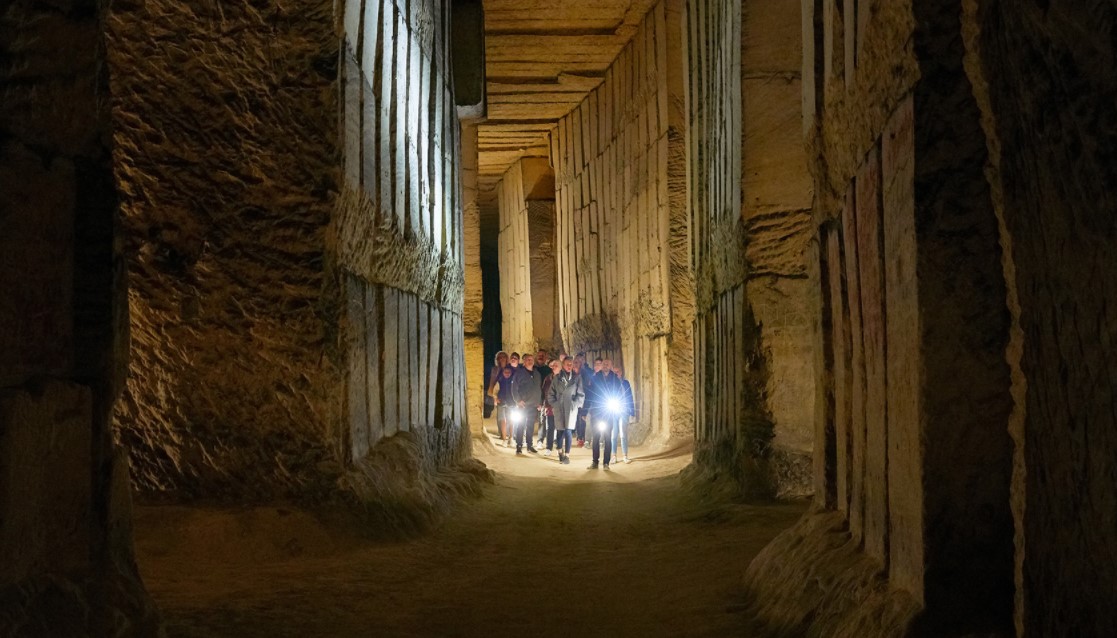
Beyond Caves North Maastricht
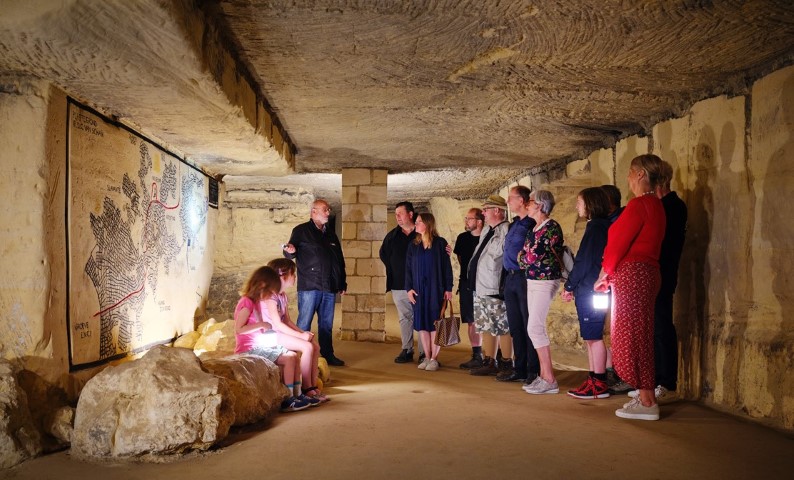
We move on there is still plenty to see! Leaving the cave entrance to your left, go up the small hill and through the swing gate into the meadow. You now enter a beautiful meadow where you can have a nice run or rest on a bench. Which river do you see in the distance? Continue straight ahead through the meadow and leave the meadow again via a swing gate and follow the path straight ahead. On your right you will see beautiful cows and maybe a pig, if you are lucky. At the junction, turn left, another climb up. Come on! You can do it, just a little more climbing. The road bends to the right. Just walk straight ahead until you reach the entrance to Grotten Noord. If you dare to visit the Grotten Noord, you can do so with a Maastricht Underground guide. You will explore with the guide some of the approximately 8,000 corridors that lie beneath the St Pietersberg. You will discover beautiful drawings, can saw like a block breaker in a marl block and listen to stories about the Mosasaurus. Maybe you will also succeed in making fire with a flint and the guide will show you the Vault. The Night Watch was kept in the Vault during World War II.
Did you know that Caves North and Caves Zonneberg were connected? You could walk in here and come out again at Caves Zonneberg where you were a moment ago. Unfortunately, this is no longer possible because ENCI has excavated the marl to make cement. At the viewing platform, you could see that a huge hole has been dug. Fort Saint Peter does still connect to the Caves North through a 38-metre spiral staircase.
Back at Fort Sint Pieter
Now walk back a bit so that you reach the junction again. Walk up the paved road here and keep to the right. If you walk straight ahead here, you will pass through the dog-walking area. Both routes are possible, you can choose here. In front of you you can see the Fort Sint Pieter , where you started and where this experience walk ends.
One last fact. Did you know that the lighting here, at the car park Fort Sint Pieter, is bat-friendly lighting? Bats are nocturnal animals, they function best in a dark environment and are very sensitive to light disturbance. That is why these lights are red in colour in the evenings and at night.
Discover more of Maastricht?
Curious about Maastricht underground? Then be sure to join a guide from Maastricht Underground! Bring your torch, good shoes and a jacket and go on an adventure! Or would you like to discover Maastricht above ground guided by a Maastricht expert? Then be sure to check out our city walks in Maastricht.
This free walking route is inspired by Natuurmonumenten's walking route.