

Maastricht Walking Route details
This walk is perfect for young and old, whether you are out and about with children or socialising with friends. Come and be taken on a surprising journey of discovery full of stories and history. The route is open to everyone, so families with children, couples and friends can fully enjoy beautiful Maastricht.
The walk starts at the Graanmarkt, near Maastricht's big star, and takes you through one of the city's most atmospheric neighbourhoods.
Distance :3.2 km | Duration: 40 minutes
Tip: download the route as a GPX file and then open it in a GPX viewer app.
Do you prefer a guided tour? Then take a look at our offerings underground and aboveground Maastricht:
Welcome to the Graanmarkt Maastricht
Sit on the cannons, run across the lawn and climb the steps of the 'Hoeg Brök' and back down again. The legs are now loose for a walk through the city park. Let's go exploring! Have fun!
Just walk to the small wooden bridge towards the large pond near the Rondeel 'the Vief Köp'. The name of the 'Vief Köp' (the Five Heads) comes from the so-called 'Betrayal of Maastricht' in 1638. The Spaniards tried to regain control of Maastricht. A soldier from Maastricht was willing to cooperate to let them into the city. His house was on the city wall and he would remove some marl blocks from the wall so that the Spaniards could enter the city. Unfortunately, this little plan fell apart. The Maastricht soldier had received a lot of money for his betrayal and was spending it all over the city. Of course, that was going to get noticed! He was arrested as were 20 civilians and clerics. Father Vinck was one of the suspects; he eventually confessed because he was severely tortured. The severed heads of five suspects, including Father Vinck, were displayed on iron pins towards the South to deter the enemy. A gruesome story don't you think? Hence the name the 'Vief Köp'
Walk on, cross the road, and then you come to the next pond and the 'Haet ende Nijd' roundhouse. Did you know that you sometimes see turtles in this pond? Take a closer look! If you walk a little further, you'll see a zoo and a big bird cage on the other side. Do you see them? Then you are on the right track!
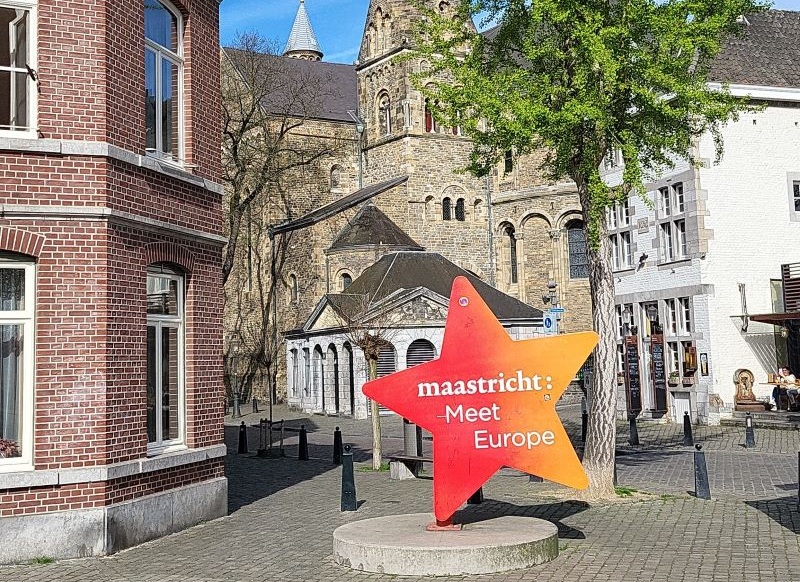
Through the Maastricht City Park
Leave the birdcage behind and continue left through the city park past the animal park. On your right you will see a beaver, carved into a tree trunk; beavers also live in the city park but you will only see them at night. A little further on the right, you see a tall pole. This is a hibernation site for bats. Did you know that as many as 1,000 bats hibernate in Maastricht's marl caves every winter?
Time to get moving again. Walk across the semi-circular bench and hang on to the stretchers you see on the opposite left. Then run across the bridge towards the great eagle owl watching the city park. Did you know that a real eagle owl lives in the Enci quarry near Maastricht?
Continue along the city wall and then immediately turn right. Here you can see d'Artagnan standing. A famous musketeer from the French army who died in Maastricht in 1673. He was hit by a musket ball. You may know d'Artagnan from Alexandre Dumas' books. He took inspiration for his books from the existing stories of the musketeers and are thus largely true stories. The statue stands here in memory of d'Artagnan; incidentally, no one knows where he is buried.
Bear Pit (Berenkuil) Maastricht
Come, let's go back towards the old bear pit. There is still plenty to do here!
No, there are no real bears here anymore, but there were real bears called Max and Pol. Around 1920, they were the first bears to come to Maastricht from a circus in Hamburg. The last bear in this enclosure was Jo the bear. Jo was transferred to the Ouwehands zoo in Rhenen. Jo was the first bear in the forest near Rhenen. There has been no bear in the city park since 1993.
And now! Climb it! Doesn't that old yew tree invite you to have a good time exploring? Just climb it quickly. Many Maastricht people have already climbed this tree. Near the climbing tree is a beautiful work of art made from a piece of tree, a Japanese scene. It is a thick and heavy branch of the Ginko tree, which broke off during a heavy storm. Behind the stump, you can climb up, between the old thick trees. Then follow the path to the left.
And look! Who is sitting there? A bear! Bear Jo will comfort you. Go and sit with him for a while. Look at his claw/hand. It has already become very smooth. And then go down and over the little bridge back to the first little bridge, where the wooden beaver is. Go left across the little bridge and under the gate.
And here's another story! Boars were here a long time ago. People were very afraid of these boars coming into the city at this place to look for food. Unfortunately, hunters had to shoot six boars before they would do much damage to park and town.
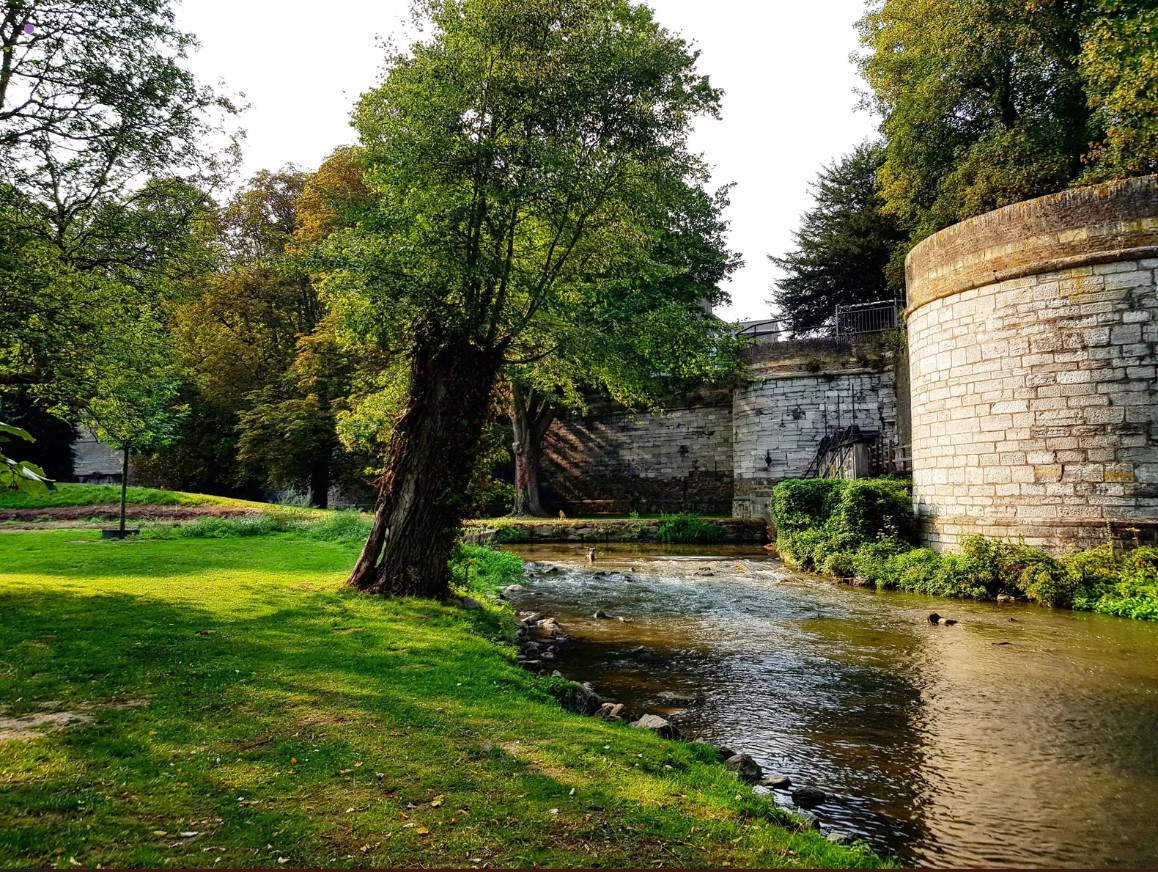
View of Fort Sint Pieter
Once you have passed under the gate, turn right and then immediately up the stairs, which brings you to the city wall. A tough climb, isn't it?
If you go left on the city wall you'll see a cannon. This one stands on a rolling horse. This is where it fired on the enemy coming from the south. Across the road you can see, in good weather, Fort Sint Pieter. Fort Sint Pieter was built around 1701 -1702 by order of Baron Daniël Wolff von Dopff. It was built in a pentagon to defend Maastricht's southern fortress walls.
Walk on, at the end of the city wall you can turn right back down towards Heksenhoek.
Whether witches live here? No! No way! Around here, a HEXE (heks translates to: witch) family lived near a water mill. The mill is no longer there. When street names had to be coined, it became the "Heksenhoek". Soon you will see a real mill.
Walk further down. At the end, you come to Bosquetplein / Grote Looiersstraat.
Rest for a moment at the statue of Fons Olterdissen. Fons Olterdissen was a Dutch writer, poet and director. He was born in Maastricht in 1865. He wrote a comic opera "Trijn de Begijn", the concluding piece of which became the official Maastricht anthem.
If you look in the direction you came from, you will see, at the very back on the right, an old convent of the Claris sisters. These sisters nursed sick people. Go and have a look. A beautiful pounding door, behind it you will find the Natural History Museum. Here you can go and see the skeleton of mosasaur Bèr. Did you know it was found in Maastricht?
Hup, we move on again! Walk down Tanner Street all the way to the end between the trees. You pass the University library on your right. Take the next street on the right, Kleine Looierstraat. You now come out on Pieterstraat, diagonally across the street you will find house number 37. In the wall you can see a small metal door with a keyhole. A city gate used to stand here. Behind that little door was the key to the city gate! Every morning someone would come and open the gate and lock it again in the evening so that everyone in the city was safe again at night.
At house number 29 you go under the gate and then you pass the Lion Mill or Clemens Mill. This mill still turns occasionally. You might get lucky and see it turning.
Walk on and you will see steps down by the thick stones, there you can walk between the 'two arms' of the Jeker. Cross the small lock. Unfortunately, we cannot go up the city wall now, so keep walking on the left towards the next, smallest, part of the city park. Cross the street to the Faliezusterpark. If all goes well, you will see the little Father Vinck tower. That's where we're going.
Legend has it that Father Vinck was imprisoned in this little tower. Right by the turret you can see the Jeker disappearing under the houses. But be careful! Watch out for wet feet!
Oldest gate in the Netherlands
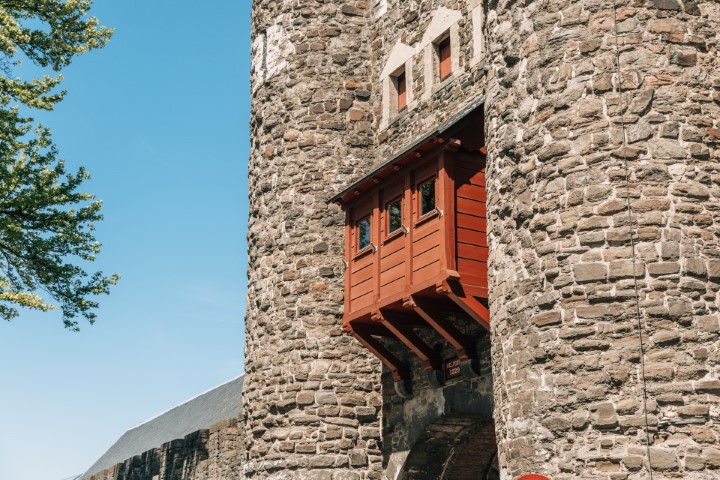
Across the little bridge you can walk towards the Helpoort (Hellgate), the oldest gate in the Netherlands. Why Helpoort?
Maastricht had a garrison and was a city of soldiers. Walls were built to defend the city against the enemy. There were not only soldiers but also many horses. The horses' hooves had to be sharpened with FIRE at the blacksmith's and fire that was the HELL. Hence Help Gate, the entrance to HELL. Is there a heaven here too? Go look for it and rest here for a while. You can then return to the starting point of this walk via the large lawn with the cannons, to the right of the Help Gate.
Discover more of Maastricht?
We hope you enjoyed the walk and also learnt a bit more about this beautiful part of Maastricht. Want to discover even more of multifaceted Maastricht? Explore Maastricht offers numerous unique city walks and guided tours. Be surprised by our passionate guides, who will take you along hidden gems, centuries-old history and special places. Whether you choose an underground tour through the marl caves or a historical city walk, there is always more to experience. Book one of our guided tours and experience Maastricht in a way you will never forget!